Multi-agent AI,
made simple
Build teams of specialized AI agents that collaborate, escalate to humans when needed, and learn from every interaction — all from a visual editor.
The modern way to orchestrate AI agents
Trusted by engineering teams building the future of AI
Messages processed
Stacks deployed
Engineering teams
Uptime SLA
The problem
You want AI agents.
But can you trust them?
Enterprises are eager to deploy AI agents but face real fears about control, visibility, and accountability.
Rogue agents
An unconstrained agent can hallucinate, loop endlessly, or access sensitive data it should never see.
Zero visibility
You don’t know what the agent is doing, why it made that decision, or how much it’s costing you.
No governance
No human validation, no audit trail, no separation of responsibilities. Good luck explaining that to compliance.
Controlled autonomy
The framework for AI you can govern
Agents are autonomous within their boundaries — but the boundaries are strict, observable, and enforced by design.
Structured hierarchy
Every agent has a defined role and scope
Tree architecture, not mesh chaos. An agent can only communicate with its children — no lateral calls, no surprises.
Full observability
You see everything, in real time
Every tool call, every delegation, every cost — traceable. Debug complex multi-agent flows with complete transparency.
Human-in-the-loop
Humans decide when it matters
Native UserNode, KB review mode, inbox with email notifications. The human is in the loop by design, not as an afterthought.
Guaranteed termination
No surprises on the invoice
Iteration limits, failure propagation, resilient retry strategy. Every workflow has a defined end — no runaway agents.
See it in action
Controlled autonomy, from design to production
Each pillar is built into the product — not bolted on. Here’s what it looks like in practice.
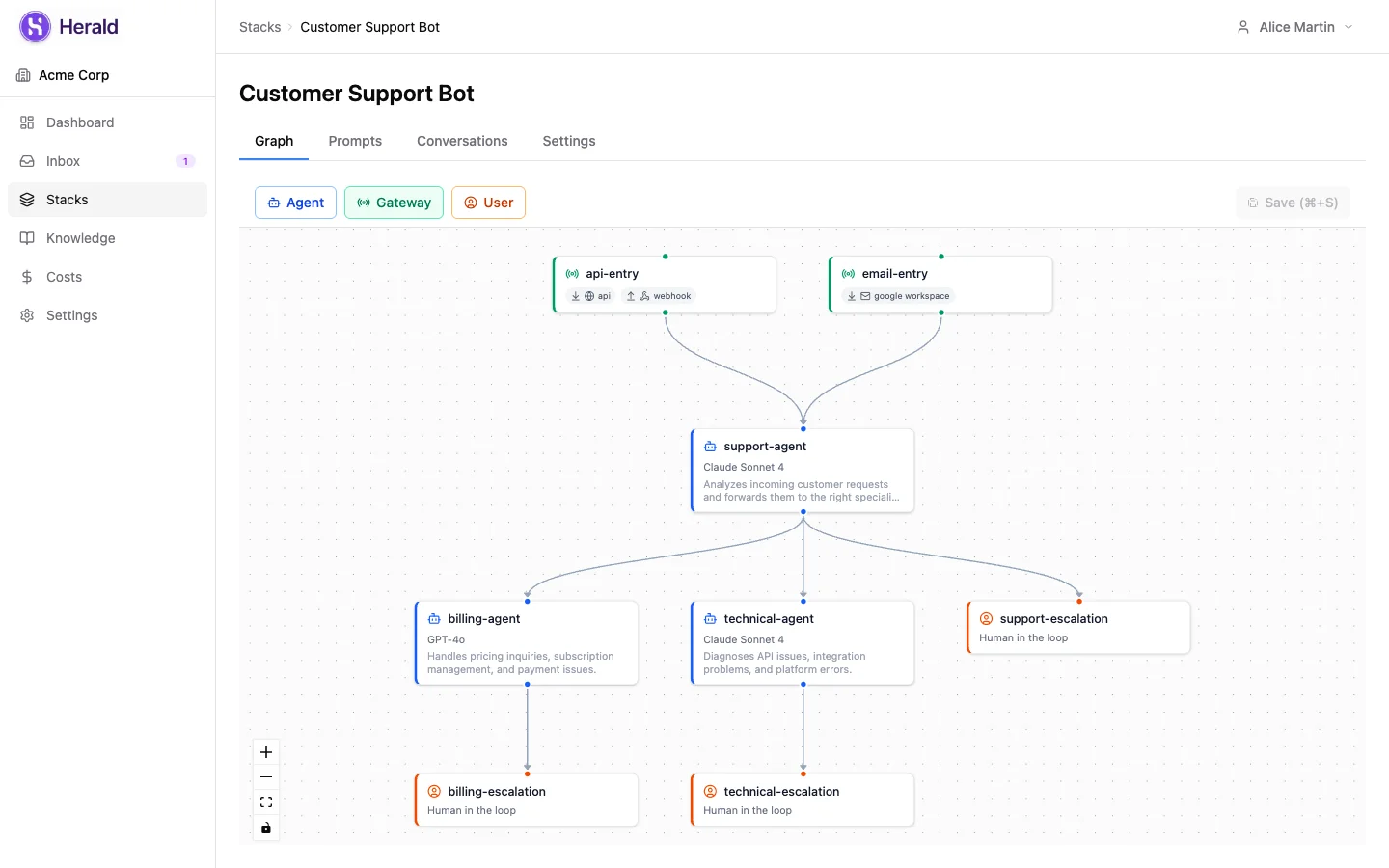
Every agent knows its place
Design multi-agent workflows as a visual tree. Each node has a defined role, its own LLM, and explicit tools. Agents communicate only with their children — no lateral calls, no emergent chaos. You see the architecture at a glance.
- Tree architecture, not mesh
- Per-agent LLM & tool assignment
- Gateway nodes for API, Slack, email
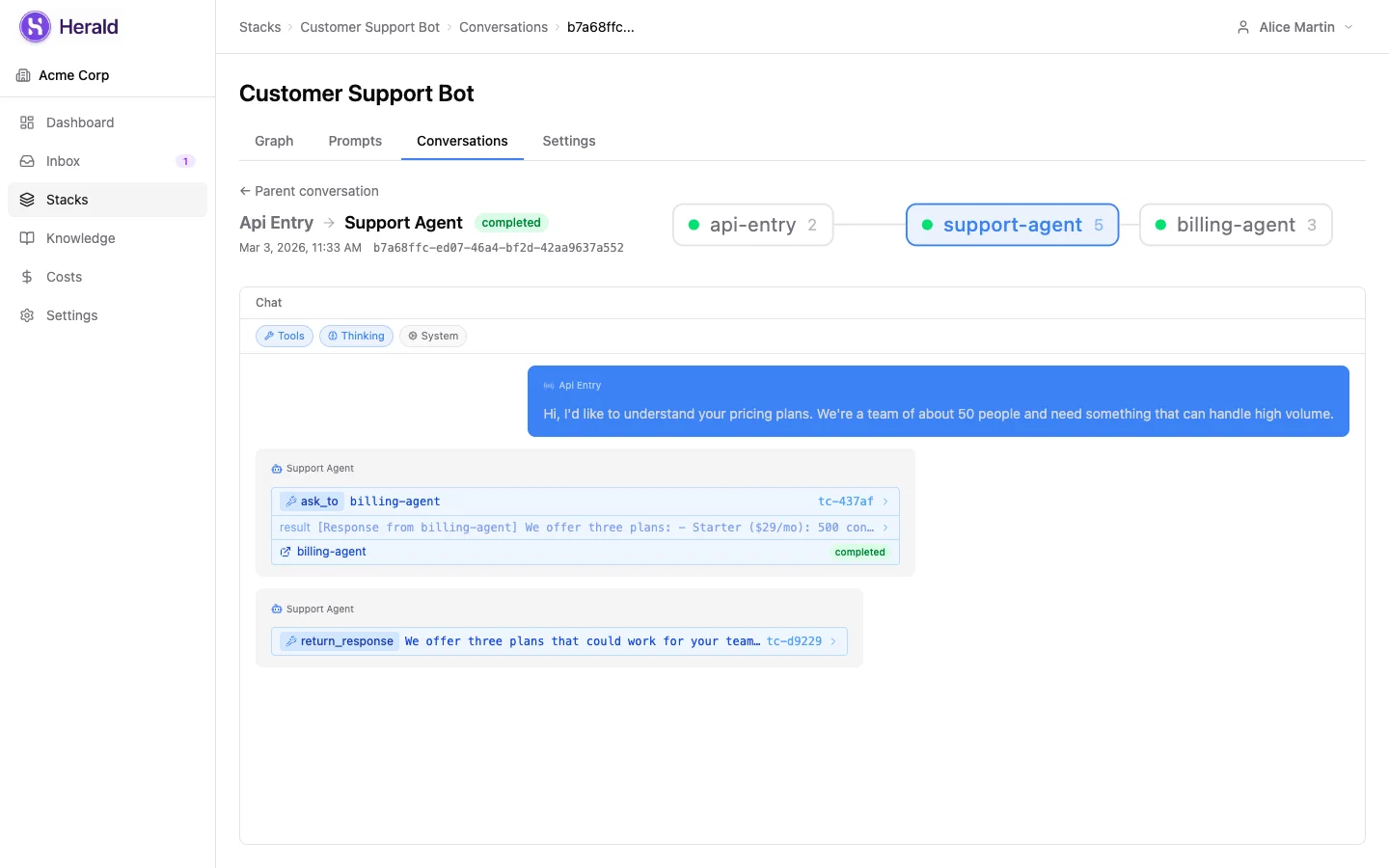
Trace every decision in real time
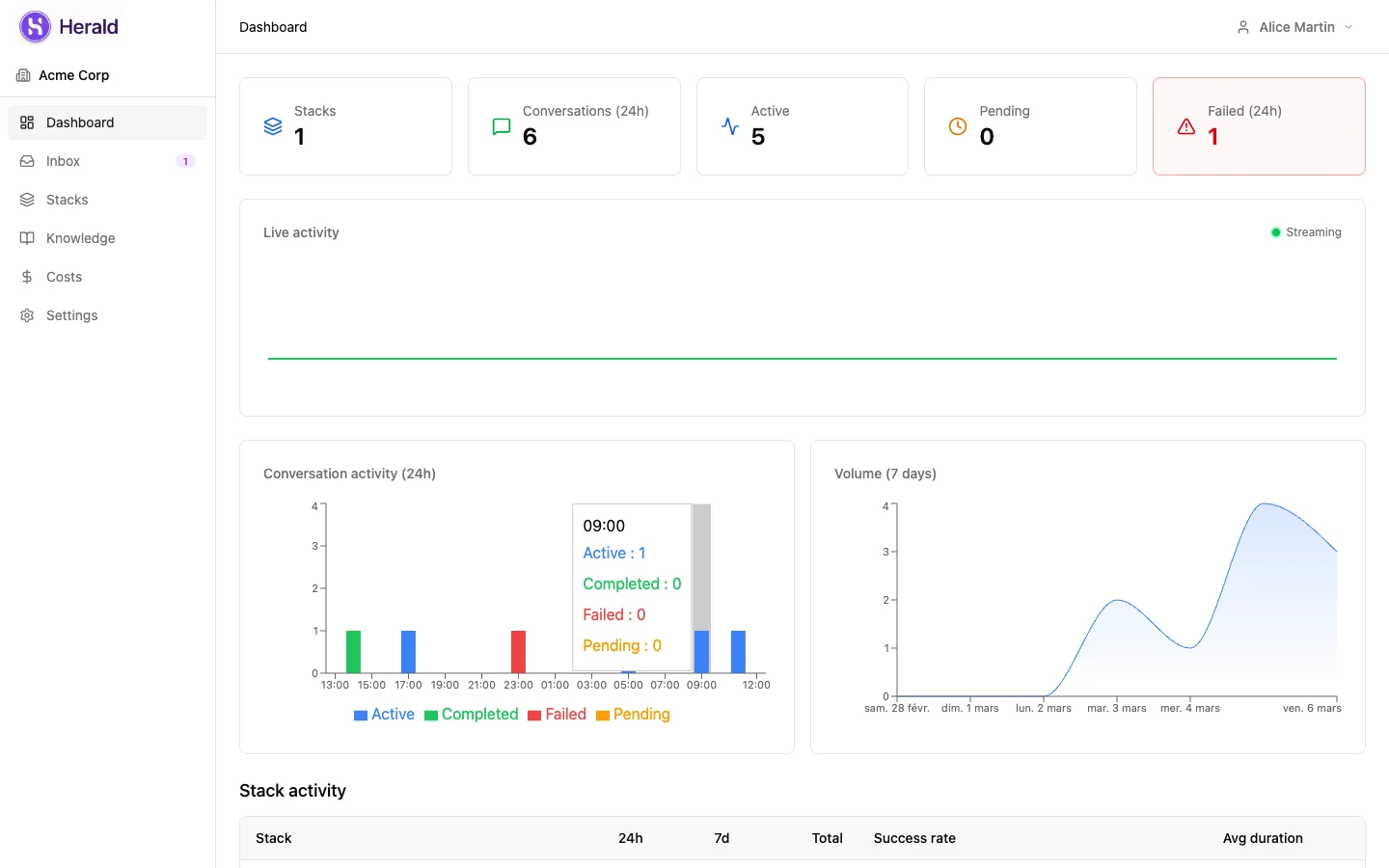
See every tool call, every inter-agent delegation, every response flowing back up the tree. Understand why an agent made a specific choice. Track costs per model, per agent, per conversation. Debug with complete transparency.
- Real-time conversation tracing
- Tool call & delegation visibility
- Multi-model cost tracking
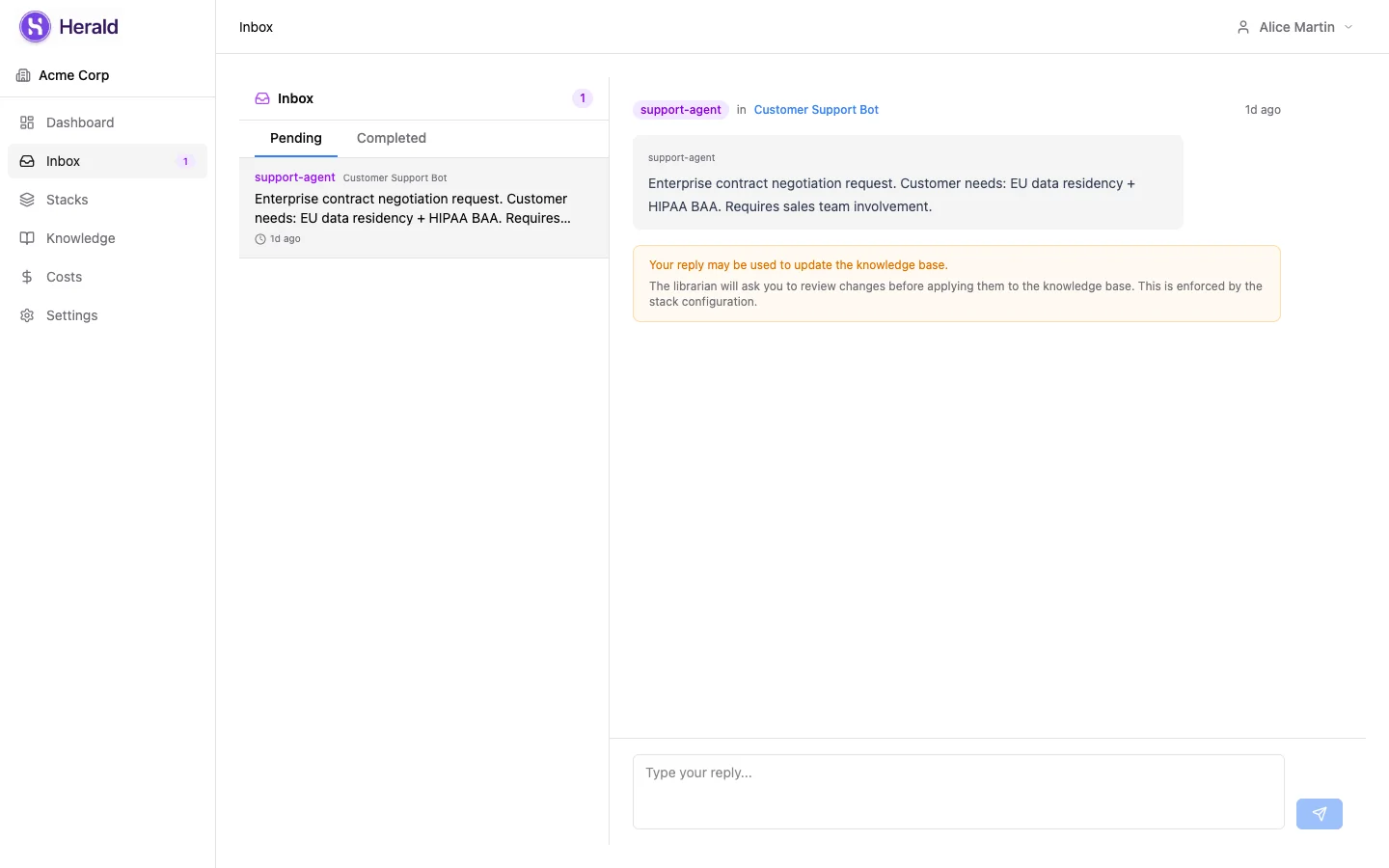
Human judgment when it matters
Agents escalate to your team when they need human input. The knowledge base review mode ensures no content changes without approval. Team members respond via inbox with email notifications — the captured knowledge feeds back automatically.
- Native UserNode escalation
- KB review mode for governance
- Email notifications + inbox
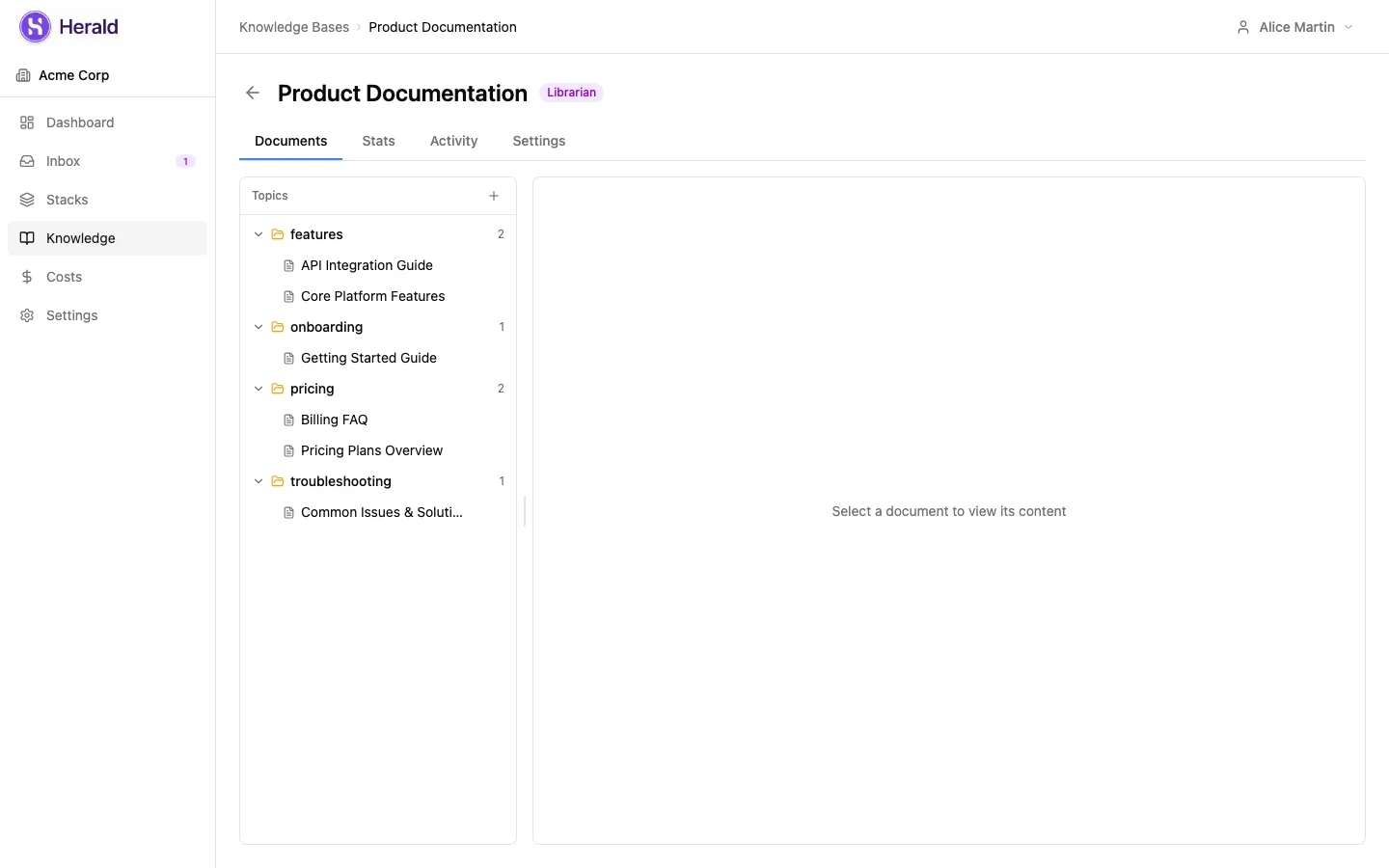
Self-maintaining knowledge base
The AI Librarian auto-curates your knowledge base after every conversation — organizing documents, deduplicating content, keeping information fresh. Agents search via hybrid semantic + keyword retrieval. Enable review mode for full governance.
- AI Librarian auto-curation
- Hybrid search (semantic + keyword)
- Review mode for quality control
How it works
Up and running in minutes
Three steps to production-ready AI agents.
Design your agents
Visual drag-and-drop editor. Build your agent tree, assign each agent a role, an LLM model, and specific tools. Add gateway nodes for your entry points.
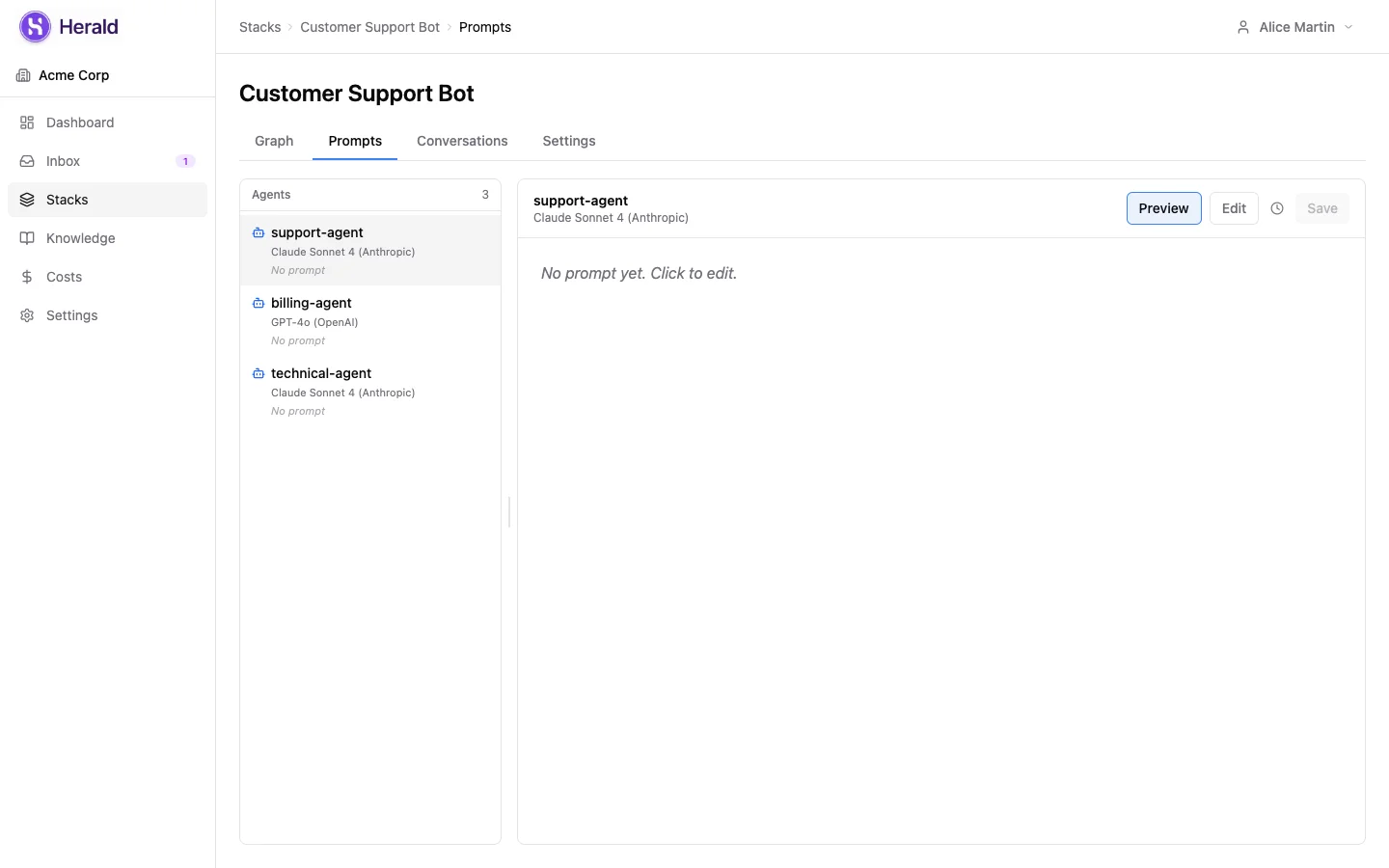
Connect knowledge & tools
Attach knowledge bases, configure integrations. 53+ pre-built tools ready to use — or create custom tools without code.
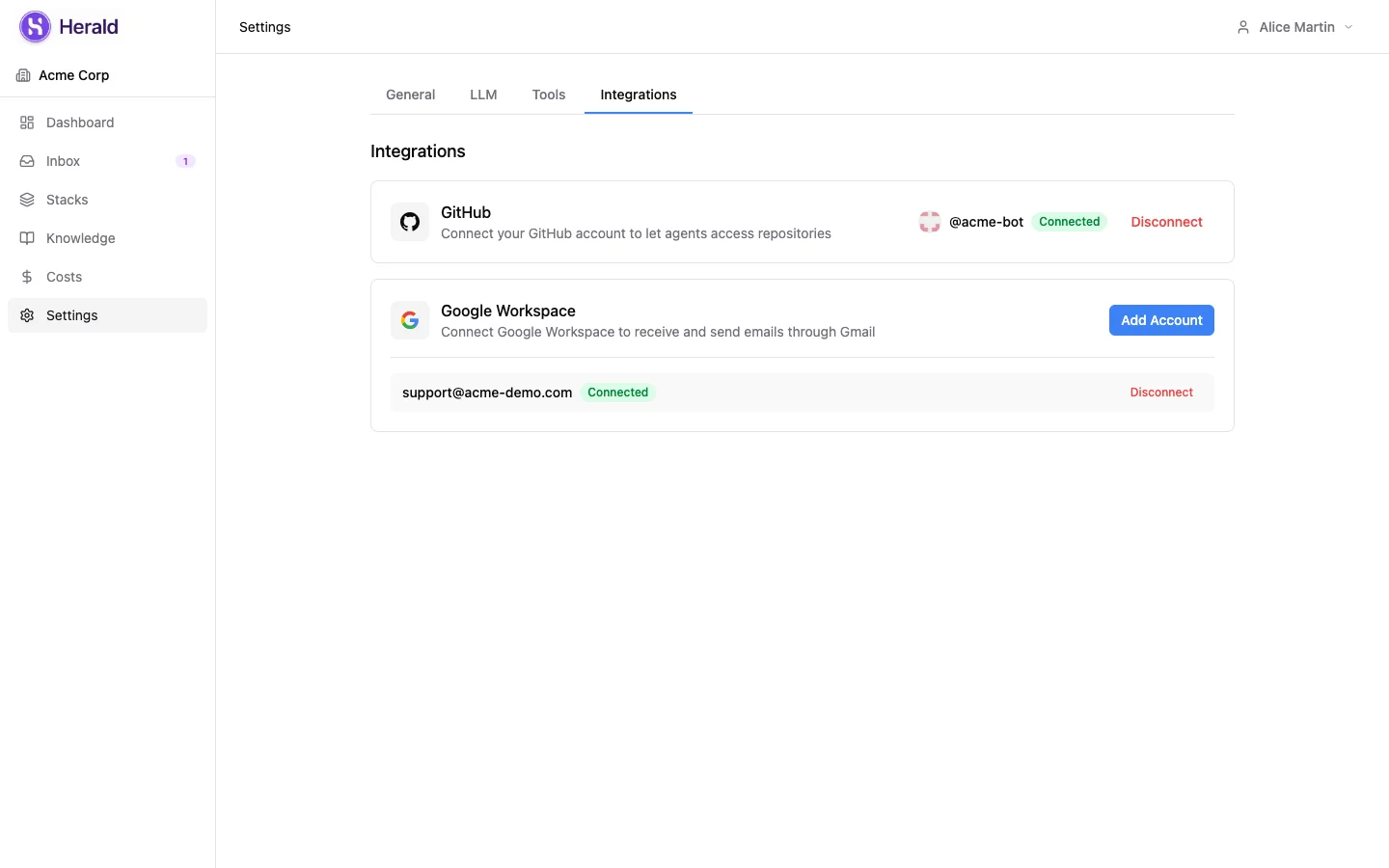
Deploy & monitor
Activate your stack. Monitor conversations in real time, track costs across models, and let the Librarian improve your KB continuously.
Capabilities
Power within the framework
Everything your agents need to work at scale — governed, observable, and production-ready.
Multimodal
Images, PDFs, text files. Your agents see, read and analyze any format.
53+ Integrations
HubSpot, Gmail, Slack, Brevo, Airtable, Apollo, GitHub. CRM, email, prospection, data.
Web Search
Native web search during agent reasoning. Agents research in real time.
Knowledge Base
Hybrid semantic + keyword search. AI Librarian for autonomous or supervised curation.
Scheduled Tasks
Proactive agents: follow-ups, nurturing, periodic checks. Schedule wakeups natively.
File System
Shared file storage across agents. Collaborate on documents, reports, and exports.
Cross-Stack Bridges
Modular composition of reusable workflows. Connect stacks together for complex pipelines.
Multi-Tenant
Every organization isolated, every stack isolated. Designed for multi-tenant from day one.
Comparison
Herald vs. open frameworks
Open frameworks give you freedom. Herald gives you control.
What CTOs say
Trusted by teams who ship AI to production
Engineering leaders chose Herald because they needed control, not just capability.
“We evaluated every orchestration framework out there. Herald was the only one where we could explain to our board exactly what each agent does and why. That’s not a feature — it’s a requirement.”
Sarah Chen
CTO, Meridian Health
“We went from prototype to 50K daily conversations in three weeks. The visual editor meant our product team could iterate on agent workflows without waiting for engineering.”
Marcus Rodriguez
VP Engineering, ScaleOps
“Our compliance team rejected our first three AI proposals. With Herald, they approved in one meeting. The audit trail and human-in-the-loop governance made all the difference.”
Priya Sharma
CTO, FinBridge
Integrate in minutes
Official SDKs for your favorite framework. Send a message, receive the response via webhook.
$composer require herald-ai/herald-bundle// Send a support email to your agent stack
$response = $this->heraldClient->sendMessage(
endpointId: 'your-endpoint-id',
message: $email->body,
systemMessages: [
"Customer: {$customer->name}",
"Plan: {$customer->plan}",
],
metadata: ['emailId' => $email->id],
);
// Receive the AI response via webhook event
#[AsEventListener]
final readonly class SupportResponseListener {
public function __invoke(HeraldResponseReceivedEvent $event): void {
$this->mailer->reply($event->metadata['emailId'], $event->response);
}
}$composer require herald-ai/herald-laravel// .env
HERALD_API_URL=https://api.herald-ai.net
HERALD_API_KEY=your-api-key
// Send a support email to your agent stack
$response = Herald::send('your-endpoint-id', $email->body, [
'systemMessages' => ["Customer: {$customer->name}"],
'metadata' => ['emailId' => $email->id],
]);
// Receive the AI response via webhook route
Route::post('/herald/webhook', function (HeraldEvent $event) {
Mail::reply($event->metadata['emailId'], $event->response);
});$npm install @herald-ai/nodeimport { Herald } from '@herald-ai/node';
// Send a support email to your agent stack
const herald = new Herald({ apiKey: process.env.HERALD_API_KEY });
const { conversationId } = await herald.send(
'your-endpoint-id', email.body, {
systemMessages: [`Customer: ${customer.name}`],
metadata: { emailId: email.id },}
);
// Receive the AI response via webhook middleware
app.post('/herald/webhook', herald.webhook((event) => {
await mailer.reply(event.metadata.emailId, event.response);
}));$pip install herald-aifrom herald import Herald
# Send a support email to your agent stack
herald = Herald(api_key=os.environ["HERALD_API_KEY"])
response = herald.send(
"your-endpoint-id", email.body,
system_messages=[f"Customer: {customer.name}"],
metadata={"emailId": email.id},)
# Receive the AI response via webhook (Flask)
@app.route("herald/webhook", methods=["POST"])
@herald.webhook
def handle_response(event):
mailer.reply(event.metadata["emailId"], event.response)Simple, transparent pricing
Start free, scale as you grow. No hidden fees.
Starter
For individuals exploring AI workflows
- Up to 3 stacks
- 1,000 conversations / month
- 1 knowledge base
- Community support
- API access
Pro
For teams building production AI agents
- Unlimited stacks
- 50,000 conversations / month
- Unlimited knowledge bases
- Priority support
- Custom tools & integrations
- Team collaboration (5 seats)
- Advanced analytics
Enterprise
For organizations with advanced needs
- Everything in Pro
- Unlimited conversations
- Unlimited seats
- SSO / SAML
- Dedicated support
- SLA guarantee
- On-premise deployment
Deploy AI agents your compliance team will approve.
Structured hierarchy, full observability, human-in-the-loop governance. Start free — no credit card required.
Free forever for small teams. No credit card required.
Enterprise-grade security. SOC 2, GDPR, ISO 27001 compliant.